
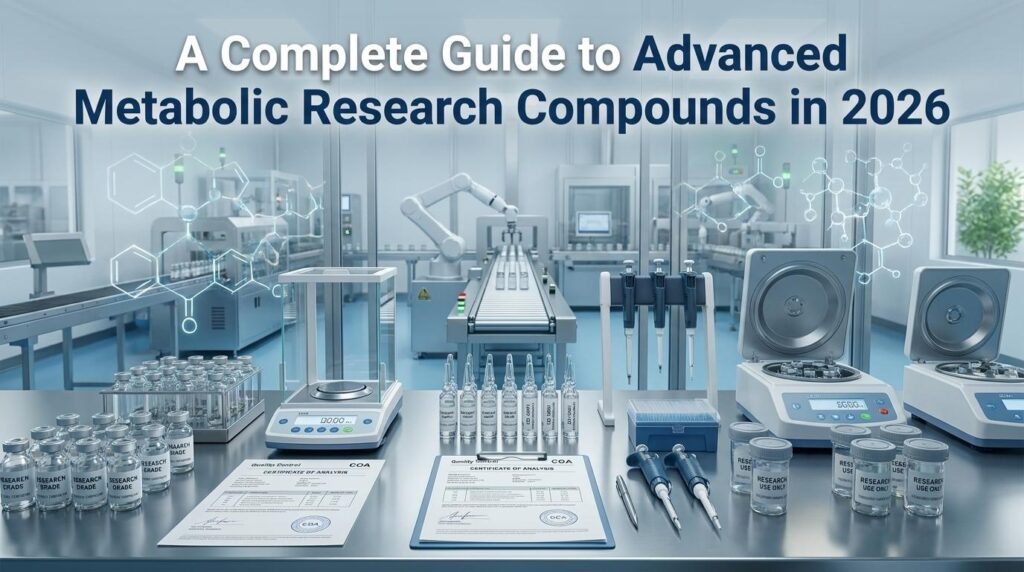
Metabolic research has moved at a remarkable pace over the last several years. In 2026, scientists and laboratory professionals have access to a growing class of advanced compounds that allow for deeper investigation into how the body regulates energy, appetite signaling, and glucose metabolism. For researchers working in this space, staying informed about what is available and how these compounds are characterized is increasingly important.
What Are Metabolic Research Compounds
A Broad and Growing Category
Metabolic research compounds are synthetic molecules studied in controlled laboratory settings for their interactions with biological pathways involved in energy balance, lipid regulation, and hormonal signaling. They are not treatments or medications. They are research tools designed to help scientists better understand complex physiological systems.
The field has expanded significantly as interest in metabolic dysfunction has grown within the broader scientific community. Compounds that target multiple receptor pathways simultaneously have become a particular area of focus because of the insights they can offer into overlapping regulatory systems.
Peptides as Research Instruments
Synthetic peptides represent one of the most active subcategories within metabolic research. These short chains of amino acids are engineered to interact with specific receptors in ways that allow researchers to observe and measure downstream biological effects under controlled conditions.
Their relatively predictable behavior in laboratory settings and the ability to synthesize them with a high degree of precision makes them valuable instruments for hypothesis-driven research.
Key Areas of Focus in 2026
Multi-Receptor Agonist Research
One of the most significant developments in recent years has been the emergence of compounds that act on multiple receptor types at once. Rather than studying a single pathway in isolation, these molecules allow researchers to examine how different signaling systems interact and influence each other.
This multi-receptor approach has opened new avenues of inquiry in areas like appetite regulation, insulin sensitivity, and adipose tissue dynamics. Laboratories interested in this area often look for well-characterized compounds with documented receptor affinity profiles and supporting purity data.
Researchers exploring this category frequently encounter retatrutide, a triple receptor agonist compound that has attracted significant scientific attention. Those sourcing Retatrutide Peptide for Research should prioritize suppliers who provide independent certificates of analysis and clear documentation of synthesis standards.
Incretin Pathway Research
The incretin system, which involves hormones that regulate insulin secretion in response to food intake, has been a major focus of metabolic research for years. Compounds that mimic or modulate incretin activity continue to be widely studied, and newer molecules with extended half-lives or enhanced receptor selectivity are of particular interest to researchers designing long-duration experiments.
Understanding how these pathways interact with other metabolic systems remains an active and productive area of scientific inquiry.
Sourcing Standards That Matter
Why Purity Directly Affects Data Quality
In metabolic research, the purity of your compound is not a secondary concern. Impurities can produce off-target effects that complicate data interpretation and make results difficult to reproduce. Every compound used in a serious research protocol should come with a batch-specific certificate of analysis from an independent, accredited laboratory.
This document should clearly state the purity percentage, the compound identity, and the analytical method used to verify it. Anything less than this level of documentation introduces unnecessary uncertainty into your work.
Storage and Handling Considerations
Most synthetic peptides used in metabolic research are sensitive to temperature, light, and moisture. Lyophilized powder form offers greater stability during storage and shipping, but once reconstituted, compounds typically require refrigeration and should be protected from repeated freeze-thaw cycles.
Preparing aliquots before freezing is standard practice and helps preserve the integrity of your working stock across multiple experimental sessions.
Laboratories building out their compound library for metabolic pathway studies can review options like Retatrutide Peptide for Research as part of their supplier evaluation process, particularly when assessing documentation standards and available purity data.
Practical Tips for Research Teams
Keep detailed records of every compound used, including the supplier, batch number, certificate of analysis results, and storage conditions. This documentation supports reproducibility and is often required for publication or institutional review.
When evaluating a new compound category, start with a clear research question and select compounds based on their receptor specificity and existing peer-reviewed literature rather than availability alone.
Always confirm that your institution permits the use of specific compounds before ordering, and follow all applicable safety and handling protocols for your facility.
The Takeaway
Advanced metabolic research compounds in 2026 offer laboratories powerful tools for studying some of the most complex biological systems in the body. The quality of your research depends on the quality of what you source. Prioritize documentation, supplier transparency, and proper handling at every stage.
Good science starts with good materials.
Disclaimer: All peptides and research compounds referenced in this article are intended strictly for laboratory and scientific research purposes only. They are not intended for human or animal consumption, medical use, or any therapeutic application. Always comply with your institution's protocols and all applicable regulations when procuring and handling research materials.